Thursday, May 17, 2007
Where Are We Going In This Handbasket?
Instapundit is covering a series of abuses under America's current president as professors share information, students express ideas, painters paint, religion engages minds, bloggers speak truth to power, others criticize government officials, and citizens publicly organize their views.


Friday, May 11, 2007
Saturday, February 03, 2007
Iraq To The Future
Debate never hinges on what people know, but on what people believe they know. I have yet to find myself in an argument over whether fire burns, for example, but everyone has his talking points on Iraq. Human actions can be misguided, misread, mysterious. I know, because I oppose Big Government, favor gay marriage, think bans are an "un-nuanced" way to deal with problems such as drugs and abortion, believe all levels of government have social responsibilities, reject strict gun controls, support the Iraq intervention in principle, think Bush has actually done some things correctly, want Congress to raise the minimum wage, respect Condoleezza Rice immensely, and love to challenge and be challenged. Consequently, I have been called an anarchist, a closet Republican, a closet Democrat, a fascist, and a few synonyms of "moron." Turns out that people just think differently (when they think at all).
If you know me, you probably know my four-point action theory:
1. One can view actions as legitimate or illegitimate based on the morals of those doing the actions. The idea is that ulterior motives undermine even the most righteous aim. A crime-lord's henchman can turn his bosses over to the feds, but if he does it in order to take over the operation then society is hardly better for the exchange.
2. One can view actions in terms of whether we can justify the act ourselves. The argument is that people can do good things for the wrong reasons, so the morality of the actor is separate from that of the action. A donation through convenience can benefit the needy as well as any through charity.
3. A person can also view actions in terms of how they occur. An action can be personally and objectively justified, but the methods used can damage credibility. Even Belloq knows one shouldn't use a bulldozer to find a china cup.
4. Another perspective focuses on results. The end may not justify the means, but it sure is nice when happy endings occur by providence or human hand.
This may be an oversimplification, but most people I know consider all four factors. For example, (1) there is no doubt in my mind that President Bush was political about Iraq and so engaged in some dubious exaggerations, omissions, and contacts. But then his statements were reasonably honest compared to many pundits', including a significant number that chose to mislead in the opposing direction. Certainly I never bought conservative arguments that Bill Clinton killed 4,000 Iraqis and signed the pivotal Iraq Liberation Act "for no good reason," and do not buy them now that they are liberal arguments against George W. Bush. Instead, (2) I hold my head high among the dwindling number of Iraq interventionists and speak out against unfair criticisms because blowing the lid off of a U.N.-sponsored murder-for-profit scheme, giving others the option of democracy, and pushing anti-authoritarian agendas are all traditional liberal ideas that Clinton, Bush and the vast majority of Congress, even now, deserve credit for promoting in Iraq. I also happen to think there is valid historical and moral precedent for disposing of dictators who invade neighboring countries, target Jews, bar free and fair elections, gas fellow countrymen, torture political opponents, murder into the seven digits, endorse ethnic cleansing, and have silly mustaches. (3) The manner in which this happened raises questions about the mores of both sides of the debate, although the government's failure to engage the world press and to forcefully repudiate torturers and abusers among its own ranks has done the most to allow growing numbers of people to see individuals who rape, behead, and slaughter innocents as more sympathetic. (4) Nobody can be certain of the future, especially not with "war fever" and "war fatigue" at issue, so I will not join the pundits in this particular guessing-game. I will only say that the consequences of engaging in a war without a decisive victory usually, historically match or surpass the damages from the war itself, so I hope that there is a decisive victory, that any American withdraw without one bucks the trend and, if it does not, that America will hasten to aid again.
So there ya go, a few scattered thoughts for use as fertilizer. (Sorry about the smell.)
If you know me, you probably know my four-point action theory:
1. One can view actions as legitimate or illegitimate based on the morals of those doing the actions. The idea is that ulterior motives undermine even the most righteous aim. A crime-lord's henchman can turn his bosses over to the feds, but if he does it in order to take over the operation then society is hardly better for the exchange.
2. One can view actions in terms of whether we can justify the act ourselves. The argument is that people can do good things for the wrong reasons, so the morality of the actor is separate from that of the action. A donation through convenience can benefit the needy as well as any through charity.
3. A person can also view actions in terms of how they occur. An action can be personally and objectively justified, but the methods used can damage credibility. Even Belloq knows one shouldn't use a bulldozer to find a china cup.
4. Another perspective focuses on results. The end may not justify the means, but it sure is nice when happy endings occur by providence or human hand.
This may be an oversimplification, but most people I know consider all four factors. For example, (1) there is no doubt in my mind that President Bush was political about Iraq and so engaged in some dubious exaggerations, omissions, and contacts. But then his statements were reasonably honest compared to many pundits', including a significant number that chose to mislead in the opposing direction. Certainly I never bought conservative arguments that Bill Clinton killed 4,000 Iraqis and signed the pivotal Iraq Liberation Act "for no good reason," and do not buy them now that they are liberal arguments against George W. Bush. Instead, (2) I hold my head high among the dwindling number of Iraq interventionists and speak out against unfair criticisms because blowing the lid off of a U.N.-sponsored murder-for-profit scheme, giving others the option of democracy, and pushing anti-authoritarian agendas are all traditional liberal ideas that Clinton, Bush and the vast majority of Congress, even now, deserve credit for promoting in Iraq. I also happen to think there is valid historical and moral precedent for disposing of dictators who invade neighboring countries, target Jews, bar free and fair elections, gas fellow countrymen, torture political opponents, murder into the seven digits, endorse ethnic cleansing, and have silly mustaches. (3) The manner in which this happened raises questions about the mores of both sides of the debate, although the government's failure to engage the world press and to forcefully repudiate torturers and abusers among its own ranks has done the most to allow growing numbers of people to see individuals who rape, behead, and slaughter innocents as more sympathetic. (4) Nobody can be certain of the future, especially not with "war fever" and "war fatigue" at issue, so I will not join the pundits in this particular guessing-game. I will only say that the consequences of engaging in a war without a decisive victory usually, historically match or surpass the damages from the war itself, so I hope that there is a decisive victory, that any American withdraw without one bucks the trend and, if it does not, that America will hasten to aid again.
So there ya go, a few scattered thoughts for use as fertilizer. (Sorry about the smell.)
Sunday, May 28, 2006
Indonesia Calls For Aid
Please offer what you can to help the people of Java.
And while people are most important, many of them have other loved ones that also need care.
And while people are most important, many of them have other loved ones that also need care.
Sunday, May 21, 2006
Saturday, May 20, 2006
The Language Gap As A Handicap?
The following is an essay I wrote in April concerning a series of articles on America's English-only debate.
English dominates the United States as the nation’s de facto language of commerce and entertainment. Although scattered pockets of non-English speakers and nods to “cultural diversity” fragment the language’s cultural reign, it is otherwise monolithic in its influence. Robert D. King’s “Should English Be the Law?” S. I. Hayakawa’s “Bilingualism in America: English Should Be the Official Language,” Greg Lewis’ “An Open Letter to Diversity’s Victims,” and Myriam Marquez’s “Why and When We Speak Spanish in Public” use well-reasoned arguments to explore the role English plays in American life as well as the extent (if any) languages such as Spanish threaten its supremacy. King and Marquez argue that the English-speaking majority is in no danger and should accommodate non-English speakers. Lewis and Hayakawa argue that non-English speakers should adapt to the mainstream for their own good as well as that of the masses. Each brings so many different views to the discussion that a reader may easily support making English mandatory in public schools while simultaneously opposing a law making English the official language of the United States.
For instance, King frames his argument with histories of the Official English movement and of other national languages, balancing his own observations in such a way that they could seem indifferent were it not for the nine pages leading to his proposed solution: “Benign neglect is a good policy for any country when it comes to language, and it’s a good policy for America.” Lewis is keen to report such facts as California’s English-only education substantially improving Hispanic elementary students’ grades, but he is blunter in his assessment of administrators who supported the earlier system of bilingual education (“liberal educational segregationists,” he calls them); he is downright quarrelsome when he segues into a tangent involving Ebonics and employment. Marquez is the most personable of the quartet, largely due to a first-person narrative drawn from her life as an Hispanic in America. The most reasonably passionate is Hayakawa. He has no difficulty providing data similar to Lewis’, but he also supplies his own experiences as an American, a son of immigrants, and a politician. Sentences such as “As a former resident of California, I am completely familiar with a system that uses two official languages, and I would not advise any nation to move in such a direction unless forced to do so” provide introductions for his essay’s supporting details.
One of those details cited by Hayakawa is the extensive use of English in India, arguably because the country would be in a multilingual muddle otherwise. This answers King’s contention that “India gets along pretty well with a host of different languages,” a rather bold remark considering how King adds that “English functions more nearly than Hindi as India’s lingua franca” without addressing why. This is probably because King regards languages as nothing compared to the “unique otherness” of a nation’s dominant character: his other example of multilingualism, Switzerland, is actually further removed from American size, population, and culture than India, but it possesses a solid cultural identity that enables it to function well with four different languages. However, his appears to be a minority view. Hayakawa, Marquez, and Lewis presume that language is a key component of cultural identity.
So while King suggests that “America has that unique otherness,” Hayakawa suggests it means nothing if Americans cannot communicate that “otherness” to one another. Hayakawa writes, “While it is certainly true that our love of freedom and devotion to democratic principles help to unite and give us a mutual purpose, it is English, our common language, that enables us to discuss our views and allows us to maintain a well-informed electorate, the cornerstone of a democratic government.” The argument is that America is a nation of immigrants, and “English unites us as American-immigrants and native-born alike.” Marquez strongly resists the notion that one must speak English to become culturally American, yet concedes that when she and her family speak Spanish it is because they wish to maintain ties to their ancestral culture, indicating that language is in fact very important to social integration. Lewis proposes that the reason behind American bilingual education is that Hispanic children should not have to learn English because they “are at risk for losing their cultural identity” by learning English. Hayakawa tones that notion down to merely say that bilingual education sometimes comes “dangerously close” to making avoidance of English the main goal, a declaration that still seeks to undermine claims that English’s presence in America is secure. King admits that “in much of the world, ethnic unity and cultural identification are routinely defined by language,” so it is fair to ask whether it is wrong for Americans to define Americanism as including English speech.
France is a major example of national identity through language, as President Chirac recently highlighted when he stormed out of a summit after a fellow countryman favored English and refused to do a presentation in French. Note that France maintains the Académie Française, a government entity devoted to preventing the “corrupting forces” of foreign language. Should French be law? Does a language spoken by a clear majority justify creating law to ostracize speakers of a minority language and thereby restrict their freedom to express themselves in whatever way they can? Thomas Jefferson observed, “Rightful liberty is unobstructed action according to our will within limits drawn around us by the equal rights of others. I do not add ‘within the limits of the law’ because law is often but the tyrant's will, and always so when it violates the rights of the individual.” Like King, Marquez contends, “From its inception, [the United States] was careful not to promote a government-mandated official language.” Perhaps the reality is English’s influence in American culture is not absolute, and that is not necessarily a negative value. There are non-English speakers living in the United States who may be unwilling to learn the language due to age, disinterest, or situation, but they are capable of exercising their rights as Americans.
Countering that last thought is the observation that they cannot exercise their rights as well as English speakers. Both sides of the debate offer variations on the idea that exclusively speaking a foreign language is crippling in American society. King writes, “It has always been taken for granted that English is the national language, and that one must learn English in order to make it in America.” Indeed, Lewis argues that “To succeed in America—with a number of relatively minor although often highly visible exceptions—it’s important to speak, read, and understand English as most Americans speak it.” Hayakawa reports how many Hispanic students fail academically in America because they were not taught English from the start. Marquez concurs that “to get ahead here, one must learn English.” There is agreement that the language gap is a hindrance for the minority, so the real issue is one of correcting that imbalance.
Please recall that King sides with leaving the matter to correct itself. Marquez appears to support government assistance for those who speak little or no English, as when she references voting ballots for German speakers in 19th century Pennsylvania. This is an especially sore point for Hayakawa, who notes that contemporary efforts to do the same target only those who are not white (since Caucasians are “presumed to be able to learn English without difficulty”) and ignore that there are already ways to achieve the same end (absentee ballots, translators allowed at voting booths, etc.). His solution is to use bilingualism solely for teaching students enough English to enter regular classes within two years of their educations. Lewis’ position is simply that teaching Standard English is imperative to allowing all citizens the opportunity to succeed, and “those who promote ‘diversity’” are to blame for denying many linguistic minorities that opportunity.
That brings to mind an interesting political juxtaposition among the articles. Lewis repeatedly warns on how "liberals who still blindly support bilingual education are condemning a significant portion of Spanish-speaking children to second-class economic citizenship.” There are strong words in the sentence: ‘blindly,’ ‘condemning,’ ‘second-class,’ and they all point to ‘liberals.’ King is the only one to note that many liberals supported English-only measures (including Bill Clinton, though he later expressed regret) and many conservatives opposed them (including George W. Bush). Marquez offers no blatantly political comment whatsoever, and Hayakawa focuses his attention on the perceived failures of specific U.S. legislators and his expectations for U.S. legislators in general.
Politicians are expected to act in the best interests of their constituencies, but practical considerations also play a role. As Marquez illustrates in her interactions at home and in public, there is no linguistic takeover of America planned, there is no disrespect toward English intended, and knowing one language does not preclude the learning of another. So why should others care for an official language? More to the point, why should others pay for it? King reports that laws in Quebec kept imported goods for Passover off the shelves because they were not labeled in French. Marquez and King both point to many bilingual immigrant parents who complain about how their children are failing to learn their parents’ tongue. Consider that a claim that English’s presence in America is secure. Hayakawa’s condemnation of government bilingualism as expensive is well-taken, particularly when he draws attention to the likelihood of it costing Americans billions, but he neglects to mention the costs of uniformly enforcing any English-only law; he then claims that recognizing Spanish as well as English as official languages would open the door for the multitude of other languages spoken in the U.S. though he does not explain why creating one official language cannot have the same effect. Lewis insists that “Membership in [racial or ethnic or cultural] groups is reductive” and Americans should devote their energies to “truly positive and universal values” instead, but the idea of citizens using their individuality to contribute to society is unenforceable. It is a noble but nebulous concept. The people rather than the government must bring about the change.
The overall effect of these four articles is the feeling that English merits becoming a requirement in U.S. public schools, but that using law to enforce any language is highly questionable. Lewis and Hayakawa are right to acknowledge that being able to communicate with all quarters of society is advantageous through a shared language. King and Marquez are less persuasive in their marginalization of that idea, but they touch on the overriding matter that making English law is essentially a means of regulating speech. All make apparent that there is a language gap in America and that every American in some sense bears the chore of reconciling the sides.
English dominates the United States as the nation’s de facto language of commerce and entertainment. Although scattered pockets of non-English speakers and nods to “cultural diversity” fragment the language’s cultural reign, it is otherwise monolithic in its influence. Robert D. King’s “Should English Be the Law?” S. I. Hayakawa’s “Bilingualism in America: English Should Be the Official Language,” Greg Lewis’ “An Open Letter to Diversity’s Victims,” and Myriam Marquez’s “Why and When We Speak Spanish in Public” use well-reasoned arguments to explore the role English plays in American life as well as the extent (if any) languages such as Spanish threaten its supremacy. King and Marquez argue that the English-speaking majority is in no danger and should accommodate non-English speakers. Lewis and Hayakawa argue that non-English speakers should adapt to the mainstream for their own good as well as that of the masses. Each brings so many different views to the discussion that a reader may easily support making English mandatory in public schools while simultaneously opposing a law making English the official language of the United States.
For instance, King frames his argument with histories of the Official English movement and of other national languages, balancing his own observations in such a way that they could seem indifferent were it not for the nine pages leading to his proposed solution: “Benign neglect is a good policy for any country when it comes to language, and it’s a good policy for America.” Lewis is keen to report such facts as California’s English-only education substantially improving Hispanic elementary students’ grades, but he is blunter in his assessment of administrators who supported the earlier system of bilingual education (“liberal educational segregationists,” he calls them); he is downright quarrelsome when he segues into a tangent involving Ebonics and employment. Marquez is the most personable of the quartet, largely due to a first-person narrative drawn from her life as an Hispanic in America. The most reasonably passionate is Hayakawa. He has no difficulty providing data similar to Lewis’, but he also supplies his own experiences as an American, a son of immigrants, and a politician. Sentences such as “As a former resident of California, I am completely familiar with a system that uses two official languages, and I would not advise any nation to move in such a direction unless forced to do so” provide introductions for his essay’s supporting details.
One of those details cited by Hayakawa is the extensive use of English in India, arguably because the country would be in a multilingual muddle otherwise. This answers King’s contention that “India gets along pretty well with a host of different languages,” a rather bold remark considering how King adds that “English functions more nearly than Hindi as India’s lingua franca” without addressing why. This is probably because King regards languages as nothing compared to the “unique otherness” of a nation’s dominant character: his other example of multilingualism, Switzerland, is actually further removed from American size, population, and culture than India, but it possesses a solid cultural identity that enables it to function well with four different languages. However, his appears to be a minority view. Hayakawa, Marquez, and Lewis presume that language is a key component of cultural identity.
So while King suggests that “America has that unique otherness,” Hayakawa suggests it means nothing if Americans cannot communicate that “otherness” to one another. Hayakawa writes, “While it is certainly true that our love of freedom and devotion to democratic principles help to unite and give us a mutual purpose, it is English, our common language, that enables us to discuss our views and allows us to maintain a well-informed electorate, the cornerstone of a democratic government.” The argument is that America is a nation of immigrants, and “English unites us as American-immigrants and native-born alike.” Marquez strongly resists the notion that one must speak English to become culturally American, yet concedes that when she and her family speak Spanish it is because they wish to maintain ties to their ancestral culture, indicating that language is in fact very important to social integration. Lewis proposes that the reason behind American bilingual education is that Hispanic children should not have to learn English because they “are at risk for losing their cultural identity” by learning English. Hayakawa tones that notion down to merely say that bilingual education sometimes comes “dangerously close” to making avoidance of English the main goal, a declaration that still seeks to undermine claims that English’s presence in America is secure. King admits that “in much of the world, ethnic unity and cultural identification are routinely defined by language,” so it is fair to ask whether it is wrong for Americans to define Americanism as including English speech.
France is a major example of national identity through language, as President Chirac recently highlighted when he stormed out of a summit after a fellow countryman favored English and refused to do a presentation in French. Note that France maintains the Académie Française, a government entity devoted to preventing the “corrupting forces” of foreign language. Should French be law? Does a language spoken by a clear majority justify creating law to ostracize speakers of a minority language and thereby restrict their freedom to express themselves in whatever way they can? Thomas Jefferson observed, “Rightful liberty is unobstructed action according to our will within limits drawn around us by the equal rights of others. I do not add ‘within the limits of the law’ because law is often but the tyrant's will, and always so when it violates the rights of the individual.” Like King, Marquez contends, “From its inception, [the United States] was careful not to promote a government-mandated official language.” Perhaps the reality is English’s influence in American culture is not absolute, and that is not necessarily a negative value. There are non-English speakers living in the United States who may be unwilling to learn the language due to age, disinterest, or situation, but they are capable of exercising their rights as Americans.
Countering that last thought is the observation that they cannot exercise their rights as well as English speakers. Both sides of the debate offer variations on the idea that exclusively speaking a foreign language is crippling in American society. King writes, “It has always been taken for granted that English is the national language, and that one must learn English in order to make it in America.” Indeed, Lewis argues that “To succeed in America—with a number of relatively minor although often highly visible exceptions—it’s important to speak, read, and understand English as most Americans speak it.” Hayakawa reports how many Hispanic students fail academically in America because they were not taught English from the start. Marquez concurs that “to get ahead here, one must learn English.” There is agreement that the language gap is a hindrance for the minority, so the real issue is one of correcting that imbalance.
Please recall that King sides with leaving the matter to correct itself. Marquez appears to support government assistance for those who speak little or no English, as when she references voting ballots for German speakers in 19th century Pennsylvania. This is an especially sore point for Hayakawa, who notes that contemporary efforts to do the same target only those who are not white (since Caucasians are “presumed to be able to learn English without difficulty”) and ignore that there are already ways to achieve the same end (absentee ballots, translators allowed at voting booths, etc.). His solution is to use bilingualism solely for teaching students enough English to enter regular classes within two years of their educations. Lewis’ position is simply that teaching Standard English is imperative to allowing all citizens the opportunity to succeed, and “those who promote ‘diversity’” are to blame for denying many linguistic minorities that opportunity.
That brings to mind an interesting political juxtaposition among the articles. Lewis repeatedly warns on how "liberals who still blindly support bilingual education are condemning a significant portion of Spanish-speaking children to second-class economic citizenship.” There are strong words in the sentence: ‘blindly,’ ‘condemning,’ ‘second-class,’ and they all point to ‘liberals.’ King is the only one to note that many liberals supported English-only measures (including Bill Clinton, though he later expressed regret) and many conservatives opposed them (including George W. Bush). Marquez offers no blatantly political comment whatsoever, and Hayakawa focuses his attention on the perceived failures of specific U.S. legislators and his expectations for U.S. legislators in general.
Politicians are expected to act in the best interests of their constituencies, but practical considerations also play a role. As Marquez illustrates in her interactions at home and in public, there is no linguistic takeover of America planned, there is no disrespect toward English intended, and knowing one language does not preclude the learning of another. So why should others care for an official language? More to the point, why should others pay for it? King reports that laws in Quebec kept imported goods for Passover off the shelves because they were not labeled in French. Marquez and King both point to many bilingual immigrant parents who complain about how their children are failing to learn their parents’ tongue. Consider that a claim that English’s presence in America is secure. Hayakawa’s condemnation of government bilingualism as expensive is well-taken, particularly when he draws attention to the likelihood of it costing Americans billions, but he neglects to mention the costs of uniformly enforcing any English-only law; he then claims that recognizing Spanish as well as English as official languages would open the door for the multitude of other languages spoken in the U.S. though he does not explain why creating one official language cannot have the same effect. Lewis insists that “Membership in [racial or ethnic or cultural] groups is reductive” and Americans should devote their energies to “truly positive and universal values” instead, but the idea of citizens using their individuality to contribute to society is unenforceable. It is a noble but nebulous concept. The people rather than the government must bring about the change.
The overall effect of these four articles is the feeling that English merits becoming a requirement in U.S. public schools, but that using law to enforce any language is highly questionable. Lewis and Hayakawa are right to acknowledge that being able to communicate with all quarters of society is advantageous through a shared language. King and Marquez are less persuasive in their marginalization of that idea, but they touch on the overriding matter that making English law is essentially a means of regulating speech. All make apparent that there is a language gap in America and that every American in some sense bears the chore of reconciling the sides.
Monday, May 08, 2006
What Have I Missed?
My lengthy disappearance was the result of preparing for and attending university. I made the Dean's List my first semester with an A in English Composition, an A in General Psychology, an A+ in Introduction to Film (the instructor used the +/- scale), y tengo una A en mi clase de español.
The plan is to major in biology. I am unsure about my minor, but it will probably be photography or film & video production. My English instructor suggested I pursue a creative writing degree, but life as a starving artist can be quite a downer.
Noting accusations of liberal bias in academia, I must say that the most objective professor I had was... the film teacher! To be fair, though, the English teacher promptly apologized for her one, fleeting digression, and all of them encouraged independent thought.
I will attend Elementary Spanish II and World History I [ed: changed course] during the summer. Wish me well!
Update: Via Instapundit: James Felton, a professor of finance and law at Central Michigan University, and a colleague looked at ratings for nearly 7,000 faculty members from 370 institutions in the United States and Canada, and his verdict is: the hotter and easier professors are, the more likely they’ll get rated as a good teacher.
I liked my professors, from the two ladies with movie star looks to the 60-something men with too much/little hair, and they were only easy in the sense that they taught freshman courses. I was in the top 10 out of 300+ psych students (and that was my worst subject!), so I suggest the greatest failure of our educational system is not bias, or hotness ratings, or even depth of subject, but the neglect of critical thinking. Encouraging independent thought means little without also developing the tools (namely reason) to apply one's intellect. A women who sat behind me in film class was amazed at how much I took notes and studied, and when I said to her that studying is how one makes good grades she replied, "Maybe that's why I don't make good grades."
The plan is to major in biology. I am unsure about my minor, but it will probably be photography or film & video production. My English instructor suggested I pursue a creative writing degree, but life as a starving artist can be quite a downer.
Noting accusations of liberal bias in academia, I must say that the most objective professor I had was... the film teacher! To be fair, though, the English teacher promptly apologized for her one, fleeting digression, and all of them encouraged independent thought.
I will attend Elementary Spanish II and World History I [ed: changed course] during the summer. Wish me well!
Update: Via Instapundit: James Felton, a professor of finance and law at Central Michigan University, and a colleague looked at ratings for nearly 7,000 faculty members from 370 institutions in the United States and Canada, and his verdict is: the hotter and easier professors are, the more likely they’ll get rated as a good teacher.
I liked my professors, from the two ladies with movie star looks to the 60-something men with too much/little hair, and they were only easy in the sense that they taught freshman courses. I was in the top 10 out of 300+ psych students (and that was my worst subject!), so I suggest the greatest failure of our educational system is not bias, or hotness ratings, or even depth of subject, but the neglect of critical thinking. Encouraging independent thought means little without also developing the tools (namely reason) to apply one's intellect. A women who sat behind me in film class was amazed at how much I took notes and studied, and when I said to her that studying is how one makes good grades she replied, "Maybe that's why I don't make good grades."
Wednesday, April 12, 2006
Still Here
Apologies for the tremendous lull in posting. University coursework can be challenging! Will return to posting on events (past, present, and future) after final exams in early May.
In the meantime, treat yourselves to some Basic Hip Digital Oddio.
In the meantime, treat yourselves to some Basic Hip Digital Oddio.
Sunday, December 18, 2005
"Cheney Visits Iraq; Attacks, Kills 19"
I suppose the mainstream media's coverage of Iraq is finally getting to me, because that is how I initially read the headline, Cheney Visits Iraq; Attacks Kill 19.
Not sure if I misread this one, though. (Via Dave Barry's Blog)
Not sure if I misread this one, though. (Via Dave Barry's Blog)
Tuesday, December 06, 2005
Color-Impoverished Phosphorus (And Other Weapons Of Mass Distraction)
Scott Burgess did a fine job of exposing last month's lies about white phosphorus (further details here and here); however, the Dec 1, 2005 comment by Rabbitvoz on Burgess' follow-up provides a clue about why the myth-making began:
I am cringing in terror from some of the most disadvantaged people on Earth,
Are we talking about truly disadvantaged people, like those being slaughtered in Sudan, or the 'poor' killers who are as likely to be well-off (Osama bin Laden was disadvantaged?) and well-educated as they are the alternative? Because the reaction to the first seems to trend toward shameful indifference, and the reaction to the second involves no cringing 'round these parts (heck, most complaints seem to argue the exact opposite--that there are too many people like Amir Taheri who lack humility in response to terrorists.)
while I unleash gargantuan forces of destruction,
It takes a fascinating mind to cringe toward terror, and to do so with superior firepower.
poisonous Depleted Uranium
Michael McNeil wrote a must-read essay on depleted uranium a couple of years ago: "Depleted uranium has two possible modes of instigating biological damage--ionizing radiation due to the fact that it's a radioactive metal, and biological toxicity due to the fact that it's a 'heavy' metal. Regarding the first of these, radioactively 'depleted uranium' is basically as little radioactive as it's possible to be and still be radioactive and not inert. This may sound like a quibble, but the half-life of uranium-238, the major radioactive component of depleted uranium (since it's been 'depleted' of other uranium isotopes) is 4.5 x 10⁹ (i.e., billion) years (not '109' years as news pieces have erroneously reported). In other words, over the entire 4.6 billion year age of the Earth, the quantity of uranium-238 on this planet has decreased by only half. That is barely detectably radioactive at all, on the human timescale. Even when it does decay, virtually all (> 99.99%) of uranium-238 follows the mode of alpha decay (emission of a Helium-4 nucleus), which cannot penetrate beyond a couple of inches in air and is stopped cold by sheet of paper. Contrast with gamma rays (high energy electromagnetic radiation emitted by some radioactive decayers) which can penetrate through feet or meters of lead and are highly destructive to biological tissue. The possibility of heavy-metal toxicity by uranium is potentially of greater scientific import. That, though, is fundamentally no different than toxicity due to say lead, which has traditionally been used (without environmentalists' extraordinary complaints) as bullets on battlefields for centuries."
Or are we really writing about Depleted Uranium?
and Torture, Murder and Rape against their citizens.
Rabbitvoz should be more like the United States. Murder, rape, and torture are illegal, and those who are caught are punished (not always as they probably should be, but then justice is not always linear). Correcting problems like torture among military ranks is difficult and others are quick to see malice where there are mistakes, but necessary reform is always possible.
Ia sit at home and watch it all on Television
Careful. Press coverage can be misleading.
and pontificate about the righteous nature of the great crusade for Freedom,
"What would you do, if you were asked to give up your dreams for freedom?
What would you do, if asked to make the ultimate sacrifice?
Would ya think about all them people who gave up everything they had?
Would ya think about all them war vets, and would ya start to feel bad?
Freedom isn't free. It costs folks like you and me,
and if we don't all chip in we'll never pay that bet.
Freedom isn't free. No, there's a hefty fuckin' fee,
and if you don't throw in your buck o'five, who will?
Oooo, buck o'five. Freedom costs a buck o'five."
which for me means the Patriot Act.
Do I detect a hint of sarcasm? In the words of Eugene Volokh: "Remember, 'Patriot Act,' like 'fascism' and 'unconstitutional,' is not Latin for 'government action I don't like.'"
I am America
Did anyone not see that coming?
I am a complete nimcompoop, a hubristic arrogant, ninny
That comes through in the writing. No need to spell it out.
and such a trigger happy prick that I kill my Allies like its duck hunting season everytime any of them are stupid enough to get mixed up in the wars I make.
Some folks need to be more straightforward with arguments like this. For example, an American opponent of the Iraq intervention could find all the British or Australian armed servicemen he can, and then personally inform the soldiers of their stupidity one-on-one rather than boasting of superiority from behind a screen-name or protest sign.
I would rather bomb TV stations and shoot Journalists in the back than allow news of my atrocities to reach the world.
Intimidation of the press-at-large requires that they uniformly recognize that they are targets, but accidents are so frequent in combat zones that illegitimate kills on the battlefield are rarely convincing as deliberate acts. One can get around that challenge by shooting journalists in the public square rather than in the back, but that creates another set of problems in that murders are bad for public relations. Saddam Hussein's old method of bribing with access and information appears shrewder, and when that does not work, killing journalists' obscure friends and family does. That is the proven way to directly corrupt or threaten journalists, have them believe the threats, but not create any serious repercussions for the dictator and his stooges. Or one could try being good, support press freedoms, and also push his own stories, while the likes of Joe Katzman, Michael Yon, and StrategyPage share the lesser-known side of his atrocities.
I am just deluded enough to think this will stop the truth getting out, and also believe if my eyes are shut it is dark for everyone.
Oh, go boil your head.
I am America
Not the one I know.
My point in citing Rabbitvoz's comment is not to be snarky (that is a bonus), but to point to its needless hysteria. Intelligent criticism, not fashionable cynicism, is essential. Let's not confuse the two.
I am cringing in terror from some of the most disadvantaged people on Earth,
Are we talking about truly disadvantaged people, like those being slaughtered in Sudan, or the 'poor' killers who are as likely to be well-off (Osama bin Laden was disadvantaged?) and well-educated as they are the alternative? Because the reaction to the first seems to trend toward shameful indifference, and the reaction to the second involves no cringing 'round these parts (heck, most complaints seem to argue the exact opposite--that there are too many people like Amir Taheri who lack humility in response to terrorists.)
while I unleash gargantuan forces of destruction,
It takes a fascinating mind to cringe toward terror, and to do so with superior firepower.
poisonous Depleted Uranium
Michael McNeil wrote a must-read essay on depleted uranium a couple of years ago: "Depleted uranium has two possible modes of instigating biological damage--ionizing radiation due to the fact that it's a radioactive metal, and biological toxicity due to the fact that it's a 'heavy' metal. Regarding the first of these, radioactively 'depleted uranium' is basically as little radioactive as it's possible to be and still be radioactive and not inert. This may sound like a quibble, but the half-life of uranium-238, the major radioactive component of depleted uranium (since it's been 'depleted' of other uranium isotopes) is 4.5 x 10⁹ (i.e., billion) years (not '109' years as news pieces have erroneously reported). In other words, over the entire 4.6 billion year age of the Earth, the quantity of uranium-238 on this planet has decreased by only half. That is barely detectably radioactive at all, on the human timescale. Even when it does decay, virtually all (> 99.99%) of uranium-238 follows the mode of alpha decay (emission of a Helium-4 nucleus), which cannot penetrate beyond a couple of inches in air and is stopped cold by sheet of paper. Contrast with gamma rays (high energy electromagnetic radiation emitted by some radioactive decayers) which can penetrate through feet or meters of lead and are highly destructive to biological tissue. The possibility of heavy-metal toxicity by uranium is potentially of greater scientific import. That, though, is fundamentally no different than toxicity due to say lead, which has traditionally been used (without environmentalists' extraordinary complaints) as bullets on battlefields for centuries."
Or are we really writing about Depleted Uranium?
and Torture, Murder and Rape against their citizens.
Rabbitvoz should be more like the United States. Murder, rape, and torture are illegal, and those who are caught are punished (not always as they probably should be, but then justice is not always linear). Correcting problems like torture among military ranks is difficult and others are quick to see malice where there are mistakes, but necessary reform is always possible.
Ia sit at home and watch it all on Television
Careful. Press coverage can be misleading.
and pontificate about the righteous nature of the great crusade for Freedom,
"What would you do, if you were asked to give up your dreams for freedom?
What would you do, if asked to make the ultimate sacrifice?
Would ya think about all them people who gave up everything they had?
Would ya think about all them war vets, and would ya start to feel bad?
Freedom isn't free. It costs folks like you and me,
and if we don't all chip in we'll never pay that bet.
Freedom isn't free. No, there's a hefty fuckin' fee,
and if you don't throw in your buck o'five, who will?
Oooo, buck o'five. Freedom costs a buck o'five."
which for me means the Patriot Act.
Do I detect a hint of sarcasm? In the words of Eugene Volokh: "Remember, 'Patriot Act,' like 'fascism' and 'unconstitutional,' is not Latin for 'government action I don't like.'"
I am America
Did anyone not see that coming?
I am a complete nimcompoop, a hubristic arrogant, ninny
That comes through in the writing. No need to spell it out.
and such a trigger happy prick that I kill my Allies like its duck hunting season everytime any of them are stupid enough to get mixed up in the wars I make.
Some folks need to be more straightforward with arguments like this. For example, an American opponent of the Iraq intervention could find all the British or Australian armed servicemen he can, and then personally inform the soldiers of their stupidity one-on-one rather than boasting of superiority from behind a screen-name or protest sign.
I would rather bomb TV stations and shoot Journalists in the back than allow news of my atrocities to reach the world.
Intimidation of the press-at-large requires that they uniformly recognize that they are targets, but accidents are so frequent in combat zones that illegitimate kills on the battlefield are rarely convincing as deliberate acts. One can get around that challenge by shooting journalists in the public square rather than in the back, but that creates another set of problems in that murders are bad for public relations. Saddam Hussein's old method of bribing with access and information appears shrewder, and when that does not work, killing journalists' obscure friends and family does. That is the proven way to directly corrupt or threaten journalists, have them believe the threats, but not create any serious repercussions for the dictator and his stooges. Or one could try being good, support press freedoms, and also push his own stories, while the likes of Joe Katzman, Michael Yon, and StrategyPage share the lesser-known side of his atrocities.
I am just deluded enough to think this will stop the truth getting out, and also believe if my eyes are shut it is dark for everyone.
Oh, go boil your head.
I am America
Not the one I know.
My point in citing Rabbitvoz's comment is not to be snarky (that is a bonus), but to point to its needless hysteria. Intelligent criticism, not fashionable cynicism, is essential. Let's not confuse the two.
Tuesday, November 29, 2005
Cake & Ice Cream For C.S. Lewis
C.S. Lewis' birthday is today (or was today, by the time most of you read this).
Being a Lewis aficionado, I decided my own birthday plans should have a theme this year: Have lunch with family & friends at an Irish pub, since Lewis was born in Belfast, and then see The Lion, the Witch, and the Wardrobe on a 65-feet-high, 98-feet-wide screen.
At least the beer would make Prof. Lewis proud!
Being a Lewis aficionado, I decided my own birthday plans should have a theme this year: Have lunch with family & friends at an Irish pub, since Lewis was born in Belfast, and then see The Lion, the Witch, and the Wardrobe on a 65-feet-high, 98-feet-wide screen.
At least the beer would make Prof. Lewis proud!
Thursday, November 24, 2005

Thursday, November 17, 2005
Yes, I Can ACT
Given the circumstances, my exam turned out nicely. I needed a 21, and...
I scored a 25!
So no need for despair.
I scored a 25!
So no need for despair.
Saturday, November 12, 2005
Those Musicians Are Up To Something
Late composer George Antheil is at the heart of one of the most unusual tales of celebrity service:
At a dinner party given by Janet Gaynor, George Antheil met Hedy Lamarr. Shortly after this meeting, Lamarr and Antheil invented and patented a secret communications system, U.S. Patent 2,292,387. The patent was applied for June 10, 1941, and received August 11th, 1942. The purpose of the system was to provide reliable and jam proof control of long range torpedoes. The system involved the use of the frequency hopping principles of Spread Spectrum radio. However it was 20 years before it was put to effective use by the United States Navy in torpedo guidance systems, and 40 years before it was permitted by the FCC to be used in commercial radios. Among other things, Spread Spectrum forms the basic principle that allows the use of simultaneous multi-channel operation used in modern digital cellular telephone systems. Spread spectrum is the basis for the communications security of the strategic $25 billion MILSAT Defense communications system.
Now, rock guitarist "Skunk" Baxter serves as an adviser for the U.S. Department of Defense:
As a member of the Doobie Brothers and Steely Dan, and as a session guitarist for Carly Simon, Bryan Adams, Ringo Starr and many others, Jeff "Skunk" Baxter has been a clandestine rock and roll hero since the '70s. Now, as a specialist in terrorism, missile defense and chemical and biological warfare, he's also a covert hero for the U.S. military.
He's currently working for the Department of Defense as an adviser to the Ballistic Missile Defense Organization and has also served as a top military adviser for numerous congressmen and senators.
And country singer Clint Black talks about rocket science:
"Did you know my guitar is like a rocket?" he asks.
Show-business exaggeration? No. It's scientific fact. Black's guitar is like a rocket.
"They both resonate," explains aerospace engineer Rodney Rocha of NASA's Johnson Space Center (JSC) in Houston.
"When you pick up an acoustic guitar," Black demonstrates, "one of the first things you'll notice is the body is basically an air chamber. The shape of the chamber is designed to be 'in tune' with the sound from the strings." He plucks the E string and the body of the guitar vibrates, producing "sympathetic" E-frequencies of its own.
What are the odds on Britney Spears having a missile silo under her swimming pool?
At a dinner party given by Janet Gaynor, George Antheil met Hedy Lamarr. Shortly after this meeting, Lamarr and Antheil invented and patented a secret communications system, U.S. Patent 2,292,387. The patent was applied for June 10, 1941, and received August 11th, 1942. The purpose of the system was to provide reliable and jam proof control of long range torpedoes. The system involved the use of the frequency hopping principles of Spread Spectrum radio. However it was 20 years before it was put to effective use by the United States Navy in torpedo guidance systems, and 40 years before it was permitted by the FCC to be used in commercial radios. Among other things, Spread Spectrum forms the basic principle that allows the use of simultaneous multi-channel operation used in modern digital cellular telephone systems. Spread spectrum is the basis for the communications security of the strategic $25 billion MILSAT Defense communications system.
Now, rock guitarist "Skunk" Baxter serves as an adviser for the U.S. Department of Defense:
As a member of the Doobie Brothers and Steely Dan, and as a session guitarist for Carly Simon, Bryan Adams, Ringo Starr and many others, Jeff "Skunk" Baxter has been a clandestine rock and roll hero since the '70s. Now, as a specialist in terrorism, missile defense and chemical and biological warfare, he's also a covert hero for the U.S. military.
He's currently working for the Department of Defense as an adviser to the Ballistic Missile Defense Organization and has also served as a top military adviser for numerous congressmen and senators.
And country singer Clint Black talks about rocket science:
"Did you know my guitar is like a rocket?" he asks.
Show-business exaggeration? No. It's scientific fact. Black's guitar is like a rocket.
"They both resonate," explains aerospace engineer Rodney Rocha of NASA's Johnson Space Center (JSC) in Houston.
"When you pick up an acoustic guitar," Black demonstrates, "one of the first things you'll notice is the body is basically an air chamber. The shape of the chamber is designed to be 'in tune' with the sound from the strings." He plucks the E string and the body of the guitar vibrates, producing "sympathetic" E-frequencies of its own.
What are the odds on Britney Spears having a missile silo under her swimming pool?
Thursday, November 10, 2005
Going All The Galloway
On October 25th, the U.S. Senate's Permanent Subcommittee on Investigations released their report (PDF file) on George Galloway's testimony before them. Two days later, the United Nations' Independent Inquiry Committee into the United Nations Oil-for-Food Programme added relevant findings of their own (PDF). Among the shared accusations are that Galloway's wife received more than $120,000, and that Galloway received several million barrels of oil, with several million more allocated in his name. Blogger George at Seixon claims to have further evidence of his own, centering on Galloway's failure to register Fawaz Zureikat's donations for the Mariam Appeal and how his claim that the organization "publicly brandished [Zureikat's sponsorship] on all of our literature, along with the other donors to the campaign" appears demonstrably false.
These are not the only charges against international actors, but Galloway may be the most recognizable. He is almost certainly the loudest, apparently having become a minister of Parliament through browbeating rather than by legislative accomplishment. An English friend of mine suggests that by pursuing the MP, the U.N. and, particularly, the U.S. are playing with fire. I doubt it. For one thing, Galloway does not appear interested in becoming an American politician, and a teaching post at Berkeley seems more logical. Secondly, Galloway's Sir Oswald Mosley shtick plays well with the chattering class, but provides Lord Haw Haw-flavored entertainment for everyone else, such as this goofy attack on President Bush over Hurricane Katrina (the fisking of which I cheerfully purloin from Tim Blair)...
His is the America of Halliburton,
Curses to Bush for having a Vice President with ties to one of the world's most qualified businesses--one that has consistently served the U.S. government since World War II. We deserve less.
the M-16 rifle,
Made in Canada... (Bush is outsourcing the American War Machine!)
the cluster bomb,
Invented by Germany... And Great Britain still uses them, too.
the gated communities of the rich and of the billionaires he grew up with in Texas.
The gated communities of the rich and the billionaires Galloway knows in Syria are far more stylish.
There is another America.
I think I know this one: South America?
It is the land of the poor of Louisiana,
Oh. But as P.J. O'Rourke once noted, "Political scientist Robert Rector has worked up figures showing that when the official U.S. measure of poverty was developed in 1963, a poor American family had an income twenty-nine times greater than the average per capita income in the rest of the world. An individual American could make more money than 93 percent of the other people on the planet and still be considered poor." The poor of Louisiana are a lot richer than, say, the poor in African or Middle Eastern kleptocracies. I wonder why Galloway expresses more interest in discussing the poor of the U.S. than he did in freeing the needier people of, say, Saddam-era Iraq?
it is the land of the young men and women economically conscripted into the military.
Sure, the U.S. military is volunteer-only, but when made to choose between working at a grocery store, busing tables, or getting shot at, obviously people will rush to join the armed forces. The most damning evidence: The government offers additional financing and education to citizens in return for military service, and we even have career soldiers who "love" fighting for their country! Is any more proof of wickedness necessary?
It is the land of the glorious multiethnic mix that was New Orleans...
Complete with corruption and a murder rate nearly eight times the national average. Also, the hardest-hit section of the city, St. Bernard Parish, was 95% Caucasian. So not such a glorious multiethnic mix, really.
The oil-for-food charges are merely indicative of a more troubling problem: Galloway is a load of bull. Like too many of the "anti-war" crowd, he is not against a war on fascists; he is cheering for the other side. (Compare his appreciation for dictators to Condoleezza Rice, who literally tagged the president of Kazakhstan, brought him to a podium, and put in the position of answering questions from the press.) Galloway allegedly bruised the Senate in May; if so, it was because they failed to hold him to any rules of order: he freely dodged questions, interrupted senators, and gave a very clever performance of some very bizarre statements. (Comment at The Big Pharaoh: "US Senators are notorious gasbags who love to hear themselves talk. Apparently Galloway didn't realize that when a US Senator shuts up, he's giving you an opportunity to incriminate yourself.") It would be much more interesting to see whether Galloway could get away with his diversions in a hearing before a grand jury. Would a member of a foreign government stonewalling an American investigation, insulting American officials, demonstrating profound ignorance of American systems, and attempting to single-handedly boss the United States around impress many American citizens?
That brings us to the latest left-wing conspiracy, which is that Galloway and Bush are working together:
Where did this guy come from? Who invited him here? The answer: US Senate REPUBLICANS. As Cindy Sheehan was gathering public sympathy as the Gold Star mom against the killing in Iraq, the Republican party decided to import an easier target to pummel. So they brought over the "I-salute-your-courage, Saddam" religious fundamentalist crack-pot who can't tell us where the money went.
Maybe there is some truth to this paranoia. At the moment, few in the U.S. know or care about Galloway, but it might not be so smooth when the face of the anti-intervention movement becomes that of a man who engaged in duplicitous accounting; called the collapse of the Soviet Union "the biggest catastrophe" of his life; told Saddam Hussein, "Sir, I salute your courage, strength, and indefatigability;" cited Fidel Castro as his political hero; and in September of this year, in New York City, publicly suggested that America deserved the September 11, 2001 attacks.
These are not the only charges against international actors, but Galloway may be the most recognizable. He is almost certainly the loudest, apparently having become a minister of Parliament through browbeating rather than by legislative accomplishment. An English friend of mine suggests that by pursuing the MP, the U.N. and, particularly, the U.S. are playing with fire. I doubt it. For one thing, Galloway does not appear interested in becoming an American politician, and a teaching post at Berkeley seems more logical. Secondly, Galloway's Sir Oswald Mosley shtick plays well with the chattering class, but provides Lord Haw Haw-flavored entertainment for everyone else, such as this goofy attack on President Bush over Hurricane Katrina (the fisking of which I cheerfully purloin from Tim Blair)...
His is the America of Halliburton,
Curses to Bush for having a Vice President with ties to one of the world's most qualified businesses--one that has consistently served the U.S. government since World War II. We deserve less.
the M-16 rifle,
Made in Canada... (Bush is outsourcing the American War Machine!)
the cluster bomb,
Invented by Germany... And Great Britain still uses them, too.
the gated communities of the rich and of the billionaires he grew up with in Texas.
The gated communities of the rich and the billionaires Galloway knows in Syria are far more stylish.
There is another America.
I think I know this one: South America?
It is the land of the poor of Louisiana,
Oh. But as P.J. O'Rourke once noted, "Political scientist Robert Rector has worked up figures showing that when the official U.S. measure of poverty was developed in 1963, a poor American family had an income twenty-nine times greater than the average per capita income in the rest of the world. An individual American could make more money than 93 percent of the other people on the planet and still be considered poor." The poor of Louisiana are a lot richer than, say, the poor in African or Middle Eastern kleptocracies. I wonder why Galloway expresses more interest in discussing the poor of the U.S. than he did in freeing the needier people of, say, Saddam-era Iraq?
it is the land of the young men and women economically conscripted into the military.
Sure, the U.S. military is volunteer-only, but when made to choose between working at a grocery store, busing tables, or getting shot at, obviously people will rush to join the armed forces. The most damning evidence: The government offers additional financing and education to citizens in return for military service, and we even have career soldiers who "love" fighting for their country! Is any more proof of wickedness necessary?
It is the land of the glorious multiethnic mix that was New Orleans...
Complete with corruption and a murder rate nearly eight times the national average. Also, the hardest-hit section of the city, St. Bernard Parish, was 95% Caucasian. So not such a glorious multiethnic mix, really.
The oil-for-food charges are merely indicative of a more troubling problem: Galloway is a load of bull. Like too many of the "anti-war" crowd, he is not against a war on fascists; he is cheering for the other side. (Compare his appreciation for dictators to Condoleezza Rice, who literally tagged the president of Kazakhstan, brought him to a podium, and put in the position of answering questions from the press.) Galloway allegedly bruised the Senate in May; if so, it was because they failed to hold him to any rules of order: he freely dodged questions, interrupted senators, and gave a very clever performance of some very bizarre statements. (Comment at The Big Pharaoh: "US Senators are notorious gasbags who love to hear themselves talk. Apparently Galloway didn't realize that when a US Senator shuts up, he's giving you an opportunity to incriminate yourself.") It would be much more interesting to see whether Galloway could get away with his diversions in a hearing before a grand jury. Would a member of a foreign government stonewalling an American investigation, insulting American officials, demonstrating profound ignorance of American systems, and attempting to single-handedly boss the United States around impress many American citizens?
That brings us to the latest left-wing conspiracy, which is that Galloway and Bush are working together:
Where did this guy come from? Who invited him here? The answer: US Senate REPUBLICANS. As Cindy Sheehan was gathering public sympathy as the Gold Star mom against the killing in Iraq, the Republican party decided to import an easier target to pummel. So they brought over the "I-salute-your-courage, Saddam" religious fundamentalist crack-pot who can't tell us where the money went.
Maybe there is some truth to this paranoia. At the moment, few in the U.S. know or care about Galloway, but it might not be so smooth when the face of the anti-intervention movement becomes that of a man who engaged in duplicitous accounting; called the collapse of the Soviet Union "the biggest catastrophe" of his life; told Saddam Hussein, "Sir, I salute your courage, strength, and indefatigability;" cited Fidel Castro as his political hero; and in September of this year, in New York City, publicly suggested that America deserved the September 11, 2001 attacks.
Wednesday, November 09, 2005
A Man Of Few Words
For the time being, anyway. Apologies for not being my usual loquacious self. My only excuse is that my mind is elsewhere... and, alas, not the sort of "elsewhere" wandering minds prefer!
So, how about a link to jumping cats?
Update: Might as well offer a potpourri while I am here...
Just what the world needed: A beer advertisement that cleverly (ab)uses Carl Orff's Chiquita Banana, Carmen Miranda, whatever.
Soldiers in Iraq are using advanced technology to save lives.
Barbeque is indeed pulled pork smothered in red sauce, but as a native Memphian I must add that the sauce should be sweet rather than sour, the meat should have some gristle, and the environment is absolutely vital: It is not real barbeque unless it is homemade or comes from some hole-the-wall restaurant. High dining barbeque is a myth.
California is preparing for a real-life remake of The Birds.
Senator John Kerry is trying desperately to be taken seriously, and failing comically.
Would this discovery qualify as good sex, or bad sex?
One of the title characters in "The Lion, the Witch, and the Wardrobe" is rather wooden. Guess which one.
South London is dreaming of a politically correct Christmas. Not to be outdone, Brussels is dreaming of a politically correct Christ. (The Grinch could not be reached for comment.)
German authorities are not all smiles and sunshine: Some of Germany's taxes recently went toward the creation of Jew-hating agitprop.
Slither looks like another movie I can miss. The trailer brings back too many memories of cleaning aquariums.
Speaking of creepy things (hello, Mr. Carter), check out the National UFO Reporting Center.
And speaking of spacey things (hello, Mr. Luthor), it looks like Pluto has new-found companionship.
Film Music on the Web has my Cinderella Man and Jericho/The Ghostbreaker reviews.
For more aural goodness, try the archived shows at Mercury Theatre on the Air.

So, how about a link to jumping cats?
Update: Might as well offer a potpourri while I am here...
Just what the world needed: A beer advertisement that cleverly (ab)uses Carl Orff's Chiquita Banana, Carmen Miranda, whatever.
Soldiers in Iraq are using advanced technology to save lives.
Barbeque is indeed pulled pork smothered in red sauce, but as a native Memphian I must add that the sauce should be sweet rather than sour, the meat should have some gristle, and the environment is absolutely vital: It is not real barbeque unless it is homemade or comes from some hole-the-wall restaurant. High dining barbeque is a myth.
California is preparing for a real-life remake of The Birds.
Senator John Kerry is trying desperately to be taken seriously, and failing comically.
Would this discovery qualify as good sex, or bad sex?
One of the title characters in "The Lion, the Witch, and the Wardrobe" is rather wooden. Guess which one.
South London is dreaming of a politically correct Christmas. Not to be outdone, Brussels is dreaming of a politically correct Christ. (The Grinch could not be reached for comment.)
German authorities are not all smiles and sunshine: Some of Germany's taxes recently went toward the creation of Jew-hating agitprop.
Slither looks like another movie I can miss. The trailer brings back too many memories of cleaning aquariums.
Speaking of creepy things (hello, Mr. Carter), check out the National UFO Reporting Center.
And speaking of spacey things (hello, Mr. Luthor), it looks like Pluto has new-found companionship.
Film Music on the Web has my Cinderella Man and Jericho/The Ghostbreaker reviews.
For more aural goodness, try the archived shows at Mercury Theatre on the Air.
So, A Frog Goes Into A Bank...
A frog goes into a bank and approaches the teller. He can see from her nameplate that her name is Patricia Whack.
"Miss Whack, I'd like to get a $30,000 loan to take a holiday."
Patty looks at the frog in disbelief and asks his name. The frog says his name is Kermit Jagger, his dad is Mick Jagger, and that it's okay, he knows the bank manager.
Patty explains that he will need to secure the loan with some collateral.
The frog says, "Sure. I have this," and produces a tiny porcelain elephant, about an inch tall, bright pink and perfectly formed.
Very confused, Patty explains that she'll have to consult with the bank manager and disappears into a back office.
She finds the manager and says, "There's a frog called Kermit Jagger out there who claims to know you and wants to borrow $30,000, and he wants to use this as collateral."
She holds up the tiny pink elephant. "I mean, what in the world is this?"
The bank manager looks back at her and says...
"It's a knickknack, Patty Whack. Give the frog a loan. His old man's a Rolling Stone."
(via Ron Burbella)
"Miss Whack, I'd like to get a $30,000 loan to take a holiday."
Patty looks at the frog in disbelief and asks his name. The frog says his name is Kermit Jagger, his dad is Mick Jagger, and that it's okay, he knows the bank manager.
Patty explains that he will need to secure the loan with some collateral.
The frog says, "Sure. I have this," and produces a tiny porcelain elephant, about an inch tall, bright pink and perfectly formed.
Very confused, Patty explains that she'll have to consult with the bank manager and disappears into a back office.
She finds the manager and says, "There's a frog called Kermit Jagger out there who claims to know you and wants to borrow $30,000, and he wants to use this as collateral."
She holds up the tiny pink elephant. "I mean, what in the world is this?"
The bank manager looks back at her and says...
"It's a knickknack, Patty Whack. Give the frog a loan. His old man's a Rolling Stone."
(via Ron Burbella)
Sunday, November 06, 2005
Magic Surrealism
"We will remain here until Bush disappears from the planet or leaves Brazil, whichever comes first," said one demonstrator, Rosa Marques, a history student at the University of Brasilia.
My bet is that he will leave Brazil first. Still, I wonder... If President Bush remained in Brazil but made himself invisible (American stealth technology, of course), would they leave? What if Brazil disappeared from the planet, taking Bush with it? Sounds too David Copperfield.
Wasn't McDonald's the favorite of that other President?
My bet is that he will leave Brazil first. Still, I wonder... If President Bush remained in Brazil but made himself invisible (American stealth technology, of course), would they leave? What if Brazil disappeared from the planet, taking Bush with it? Sounds too David Copperfield.
Wasn't McDonald's the favorite of that other President?
Tuesday, November 01, 2005
Hands Off, Jedi! He's Mine!
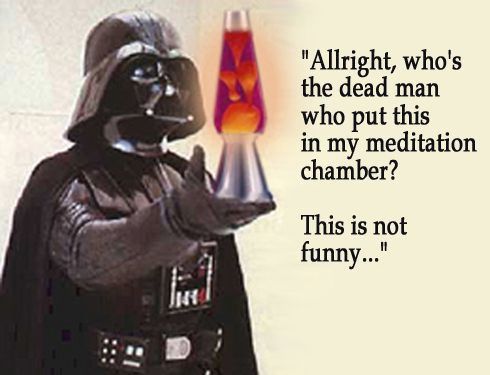
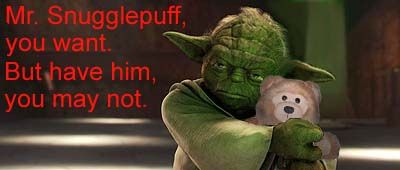
Revenge of the Sith is out on DVD today, which means I have an excuse to post this still from a deleted scene...

The movie has steamy romance, and deep affection...

It is worth owning.
The movie has steamy romance, and deep affection...
It is worth owning.
Subscribe to:
Posts (Atom)

